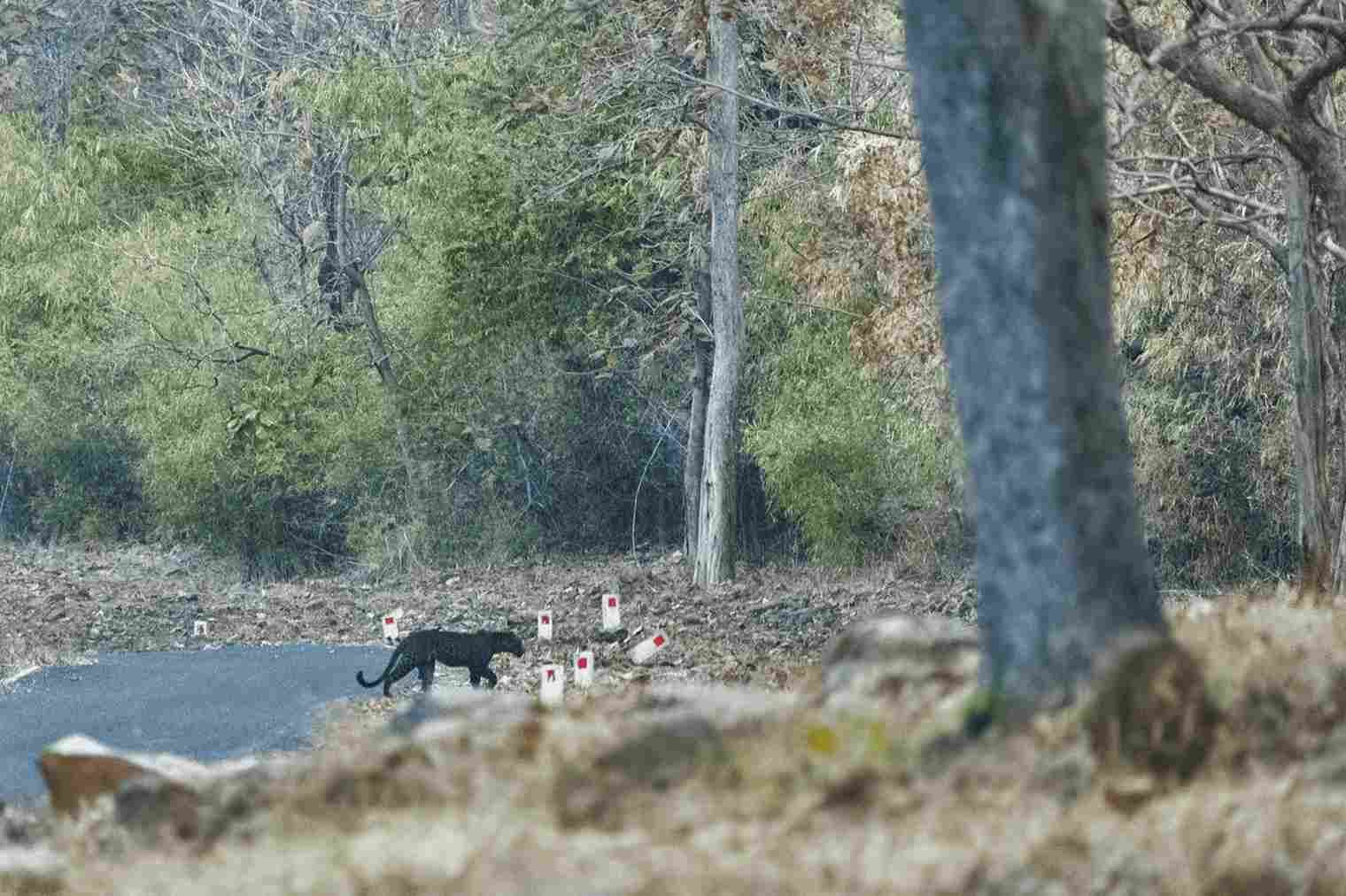
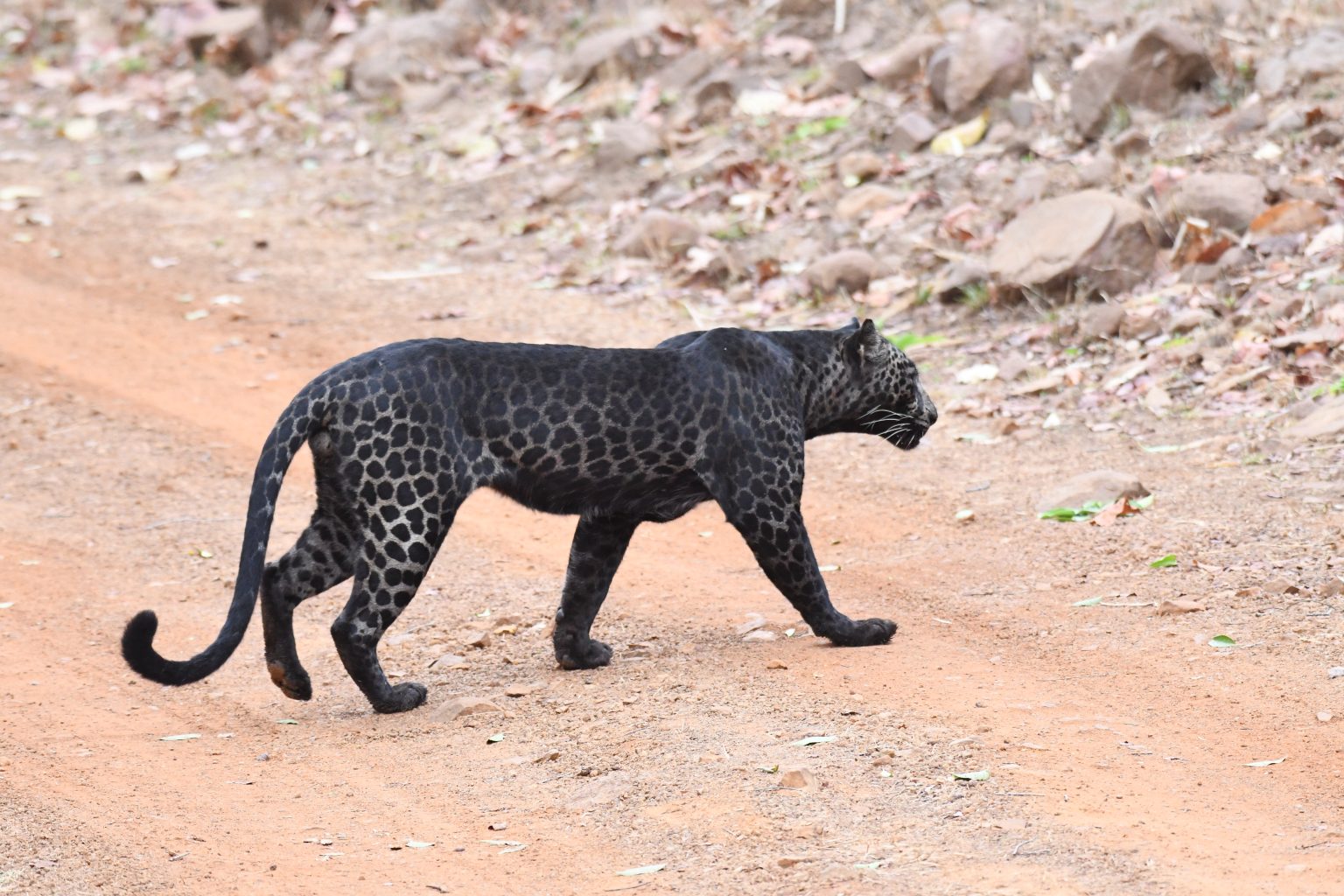
Most of us grow up imagining the black leopard as a mysterious, almost mythical creature, a rare shadow slipping through the forest. For many, it even feels like an entirely different species altogether. But the truth is far more fascinating. The black leopard in Tadoba, like those seen in a few parts of India, is simply a leopard with a unique genetic trait called melanism, which makes its coat appear almost completely black.
Before we explore why these melanistic leopards are so rare and special, it’s important to understand what melanism really means and how it shapes the appearance and behaviour of these extraordinary cats.
What is Melanism ?
Melanism is the advanced version of the dark-coloured pigment called melanin found in the skin, hair, fur or feathers of various organisms. Melanism is supposedly the outcome of a genetic mutation, but can also occur due to peculiar temperature changes during gestation. Just like human beings, wildlife is also prone to this mutation which causes excessive production of melanin, leading to a darker appearance.
Similarly, a black leopard is dark in colour due to ‘melanism’, which is quite commonly found in leopards – it’s a condition, wherein the whole skin of the animal, including its spots, is black in colour. A black panther has the darkish brown (or black) fur with black rosettes and are sometime visible under favourable light conditions. These panthers or melanistic leopards are therefore not a separate species, however a form of melanism.
Black leopard characteristics
Black leopards share the same characteristics as that of a leopard. In fact, black panthers use their melanism to their foraging advantage when they set out for hunting at night.
It was thought that black leopards are found more in regions with high rainfall and dense foliage after most of the records about the existence of black leopards in India showed their presence in North East India and Western Ghats.
However, as this is result of a genetic mutation, there isn’t any co-relation that can be attributed to the external factors. This was supported by the most recent records of black leopards being discovered in different parts of the country.
Black Leopard in Tadoba National Park
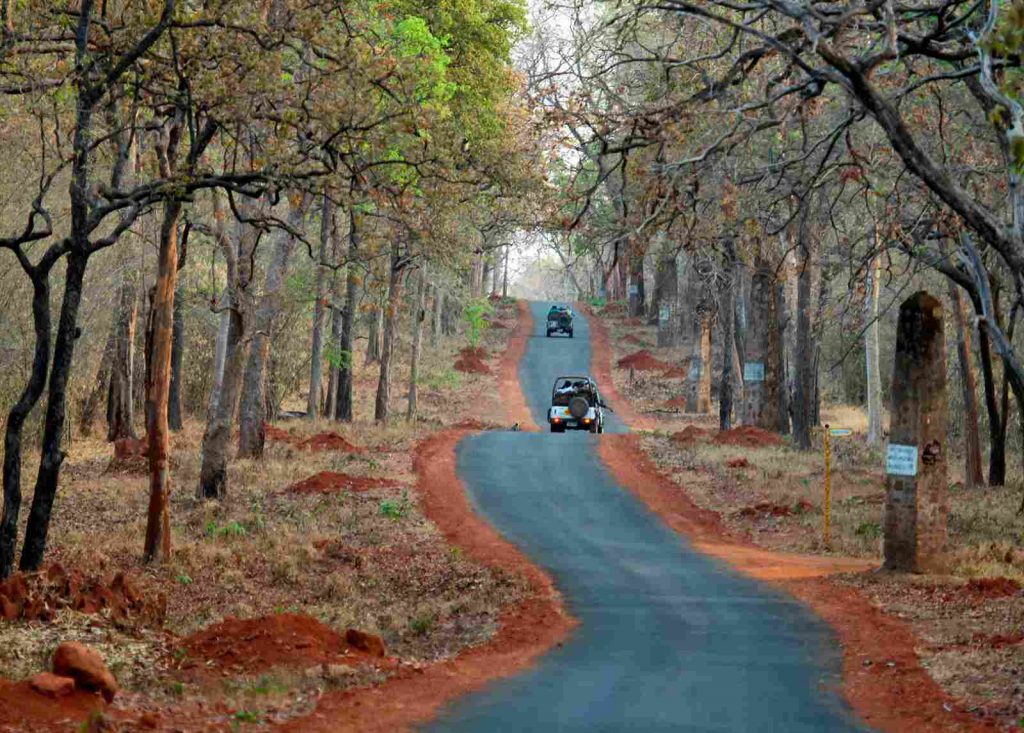
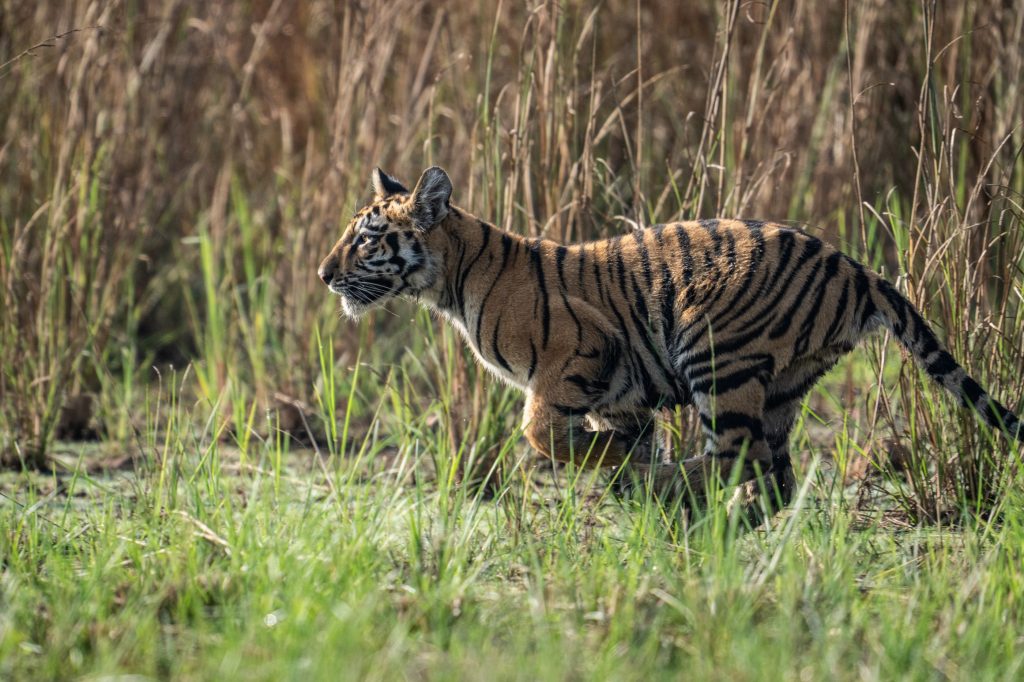
Tadoba-Andhari National Park is famously known for tiger sightings with reportedly more than 80 tigers found in the park and has gained immense popularity in recent years as the top park for tiger sightings. It is one of India’s forty-seven project tiger reserves and the largest parks in the state of Maharashtra.
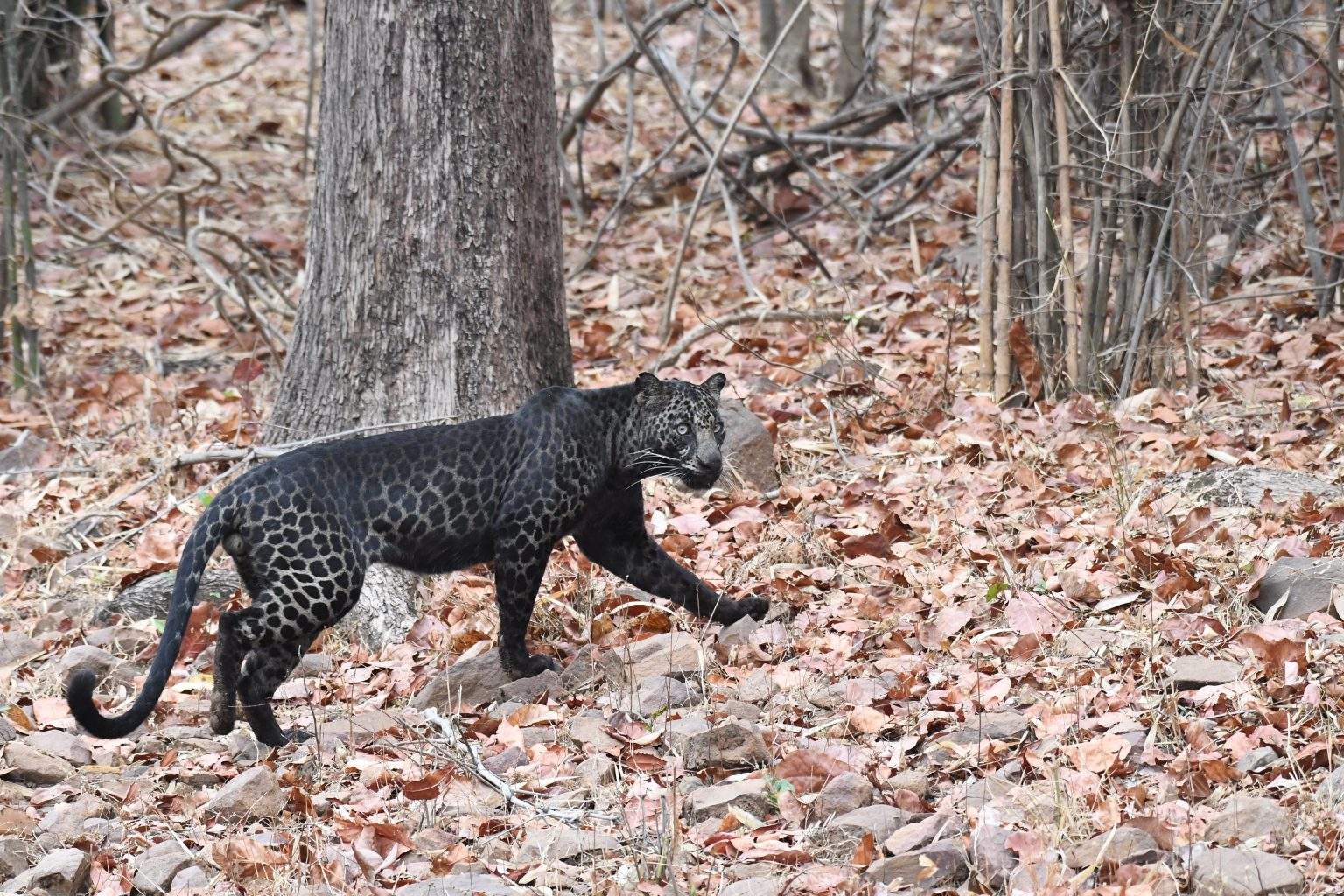
In 2018, a Belgian family was lucky to spot a sub-adult partial black leopard at a waterhole on a late evening safari in the Kolsa Range. It was difficult to believe the sighting, as black leopards in Central India were known to be rare.
However, the forest officials captured the black leopard sightings through their camera traps and the presence of black cats was confirmed. The leopard is dotingly called ‘Blackie’ by the park officials.
Do you want to know how to reach Tadoba National Park? Click here to know more.
Wrap Up
The presence of a black leopard in Tadoba is a reminder of how extraordinary India’s wilderness truly is. Melanistic leopards are not a separate species, yet their rare appearance continues to inspire naturalists, photographers, and travellers. Tadoba’s thriving forests, rich prey base, and strong conservation practices make it a landscape where such remarkable sightings are still possible.
For those hoping to experience Tadoba’s wilderness at its best, staying close to the forest can make a real difference. Nature-focused stays like Waghoba Eco Lodge, one of the best resorts in Tadoba, allow travellers to remain connected to the landscape while supporting responsible tourism. These eco-sensitive stays complement the safari experience, offering a peaceful base from which every journey into the forest holds the promise of something unforgettable, including the rare glimpse of a black leopard moving silently through the wild.

PUGDUNDEE SAFARIS
Luxury Indian Safari and Jungle Lodge Specialists
Have you ever walked on a Pugdundee?
In Hindi, Pugdundee means a foot trail used by animals and humans and refers to the narrow, beaten paths that wind through the Indian jungles. Pugdundee Safaris’ roots are in central India where we made a humble start in 1986 with a small camp in Panna. Today, we own and manage 6 exclusive safari lodges set in the breathtaking wilderness of 5 tiger reserves: Panna, Bandhavgarh, Kanha, Pench and Satpura.
Pugdundee Safaris is recognized as one of India’s leading responsible safari companies. Between 2010 and 2012, we have been awarded for our excellence in eco-tourism, our commitment to green architecture, our experienced naturalists and our pioneering mobile safari initiative.
We believe that responsible tourism and wildlife conservation go hand-in-hand. Thus, we passionately promote responsible travel, adopt sustainable practices and facilitate local involvement in conservation by empowering the communities that surround our lodges. Our dedicated team of 150 (many of whom belong to nearby villages), provide a truly authentic Indian wildlife experience.
At Pugdundee, our every endeavour is driven by our deep love for India’s forests and our passion for its wildlife. And we attempt to nurture in each of our guests, this same enduring love for India’s wild spaces.
So come, walk on a wild trail with us. A trail we call Pugdundee.